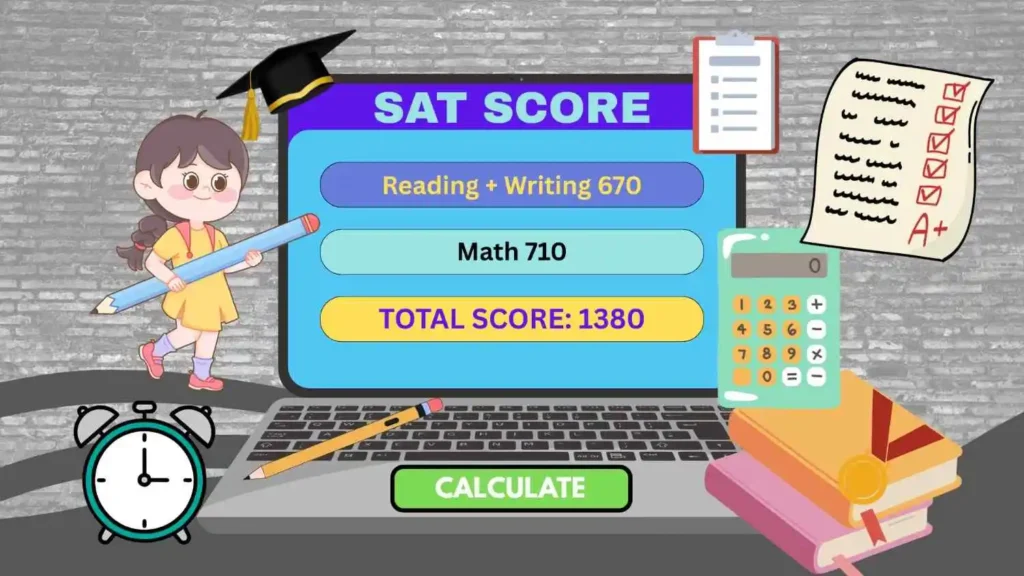
Can a Digital SAT Score Calculator really be trusted? The short answer is yes—but with a minor catch. Most online predictors are 90-95% accurate but they can’t perfectly replicate the College Board’s complex adaptive algorithm. It is a good avenue for tracking your progress, but there would be minor differences between your official results and this. In this blog, we will explain how calculators work, how official SAT scores are calculated, why the differences occur, and how to get the better predictions.
What Is a Digital SAT Score Calculator?
Consider this your own personal progress chart. A SAT score calculator computes the possible SAT scores based on the Reading & Writing and Math test questions using their correct answers. The practice data you collected produces an estimated score range that starts from 400 and ends at 1600 which allows you to verify your current progress without needing to wait for official results that take several weeks to process.
How Official SAT Scores Are Calculated
The scoring system of the SAT test is based on item response theory (IRT), which means that the score obtained is dependent on the raw score. The College Board uses an adaptive system, in which the difficulty of Module 2 increases depending on your performance in Module 1. This means two students may have the same number of correct answers, but one student might earn a higher score than the other because a “Hard” module question is worth more than an “Easy” module question.
Why SAT Score Predictions Differ From Official Scores
The reality is that online tools do not undergo the “equating” process that the College Board uses to create scoring patterns but instead use average scoring patterns. Unlike most calculators, the Digital SAT also has adaptive modules in which the level of difficulty varies with the questions. Furthermore, the scaling curve for each of the official tests is different depending on the students that took the test that day, and actual test conditions may vary from the relaxed conditions used during practice.
Digital SAT Score Calculator vs Official SAT Scores
To be honest, a calculator provides an estimated range, and official SAT scores are the exact final score released from the College Board. Imagine this: one predicts and the other decides your future score.
| Factor | SAT Score Calculator | Official SAT Scores |
| Purpose | Estimate performance | Final exam result |
| Accuracy | Approximate range | Exact score (400–1600) |
| Scoring Method | Based on general patterns | Raw score + adaptive scaling |
| Difficulty Handling | Not fully considered | Fully adaptive system applied |
| Use Case | Practice and planning | College admissions |
Now, here’s the catch: official SAT scoring involves adaptive modules, which means that the difficulty of the questions can change the final score of 2 students with the same number of correct responses.
How to Get the Most Accurate Prediction?
The emphasis here is on “how real”, but a better prediction of a student’s SAT score is just as much about how real the practice is as it is about actual performance. Do full tests with the right time and exam stress. Mark your correct answers on a good score sheet. Avoid guessing and overestimating your performance. Identify each error and practice deficient skills. The more your practice session is similar to the actual exam, the more your prediction will ring true to your actual SAT score.
Conclusion
Your SAT score isn’t based on a calculation—it’s based on your own performance under pressure. The SAT Score Calculator is an amazing tool for planning and pinpointing areas of weakness, but it’s not everything. These predictions will help to keep you motivated and focused on your strategy and help you keep going until you reach your practice score that matches your dream college’s requirements.
FAQs
Q1. How accurate is a digital SAT score calculator compared to the real test?
The scores that the majority of calculators give are within ±20 – 30 points of the official results, but adaptive scoring means that there will be no way to match scores exactly with those of the official results.
Q2. How does the adaptive nature of the test affect my calculated score?
The difficulty level of Module 2 is determined by the results in Module 1 and, therefore, affects the final scaled score as well as the accuracy of the calculator.
Q3. Is there any negative marking for wrong answers or guesswork in digital SAT?
There is no negative marking – all work is marked for correct answers, so even if you don’t know the answer, try all questions!